
Digital Barometer Weather Forecast Clock
4.3Editor score
Calibratable local pressure
4-inch multifunction display
Front button adjustments
Finding the right digital barometer is essential for tracking atmospheric pressure changes that often signal upcoming weather shifts. Whether you need a simple home station or a precise tool for labs, the market offers diverse options tailored to specific needs and budgets.
We analyzed ten top-rated digital barometers based on accuracy, display quality, wireless range, and additional features like atomic clocks and weather forecasts. Each product was reviewed for reliability, ease of setup, and user feedback to ensure you get the best value for your investment.
Each pick highlights key strengths and potential limitations to help you match a device with your environment. Note that features and availability may vary by region, and checking current listings ensures you find the exact model that suits your requirements today.
4.3Editor score

4.7Editor score

4.4Editor score
As an Amazon Associate we earn from qualifying purchases.
This side-by-side comparison highlights the key specifications and capabilities of each digital barometer to help you quickly identify the model that fits your monitoring needs.


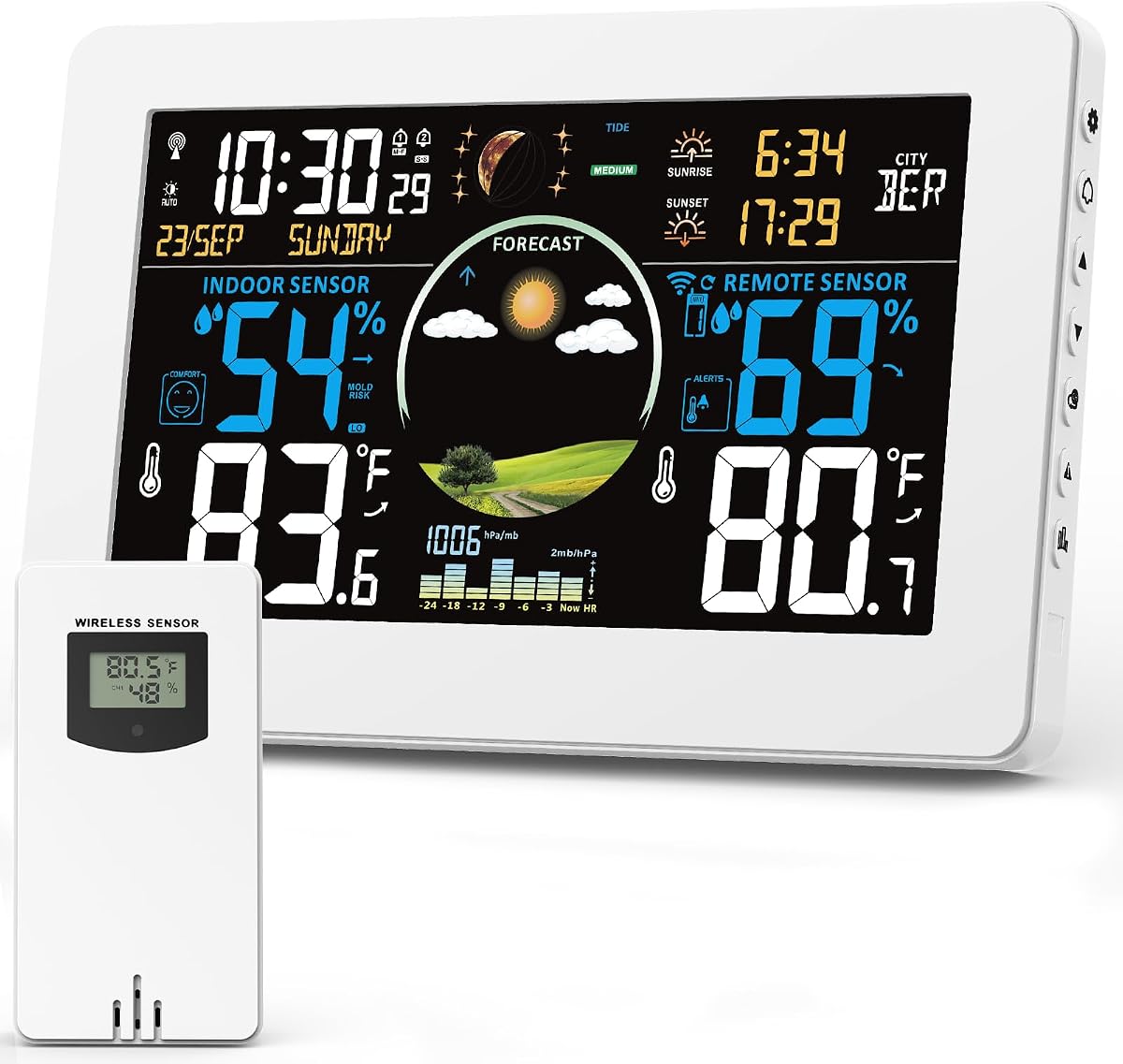

The Newentor Weather Station delivers a comprehensive suite of monitoring tools in a sleek unit. With a 4.3-star rating, it stands out for its large color LCD screen that displays indoor and outdoor conditions clearly.
We may earn a commission when you buy through this link, at no additional cost to you.
Its wireless capability supports up to three remote sensors, allowing you to track temperature and humidity across different rooms. The built-in atomic clock ensures precise timekeeping without manual adjustments, while customizable alerts warn you of significant changes.
However, users note that battery-only operation dims the screen to save energy, which might be inconvenient for constant visibility. Additionally, only one remote sensor is included in the package, requiring extra purchases for multi-location coverage.
This station is ideal for homeowners seeking an easy-to-read dashboard for daily weather tracking. It balances affordability with robust features, making it a reliable choice for general household monitoring needs.
The color LCD ensures all data is visible at a glance, reducing the need to navigate menus for basic readings.
Support for multiple sensors allows you to monitor specific areas like greenhouses or patios from a central console.
We may earn a commission when you buy through this link, at no additional cost to you.
This Traceable Calibrated Digital Barometer is designed for users who require high precision in their atmospheric monitoring. With a strong 4.7-star rating, it excels in accuracy, offering a resolution of 0.1 Hg for detailed readings.
We may earn a commission when you buy through this link, at no additional cost to you.
The large four-line LCD presents data in a graph format, making trends easy to visualize. Optional software allows you to capture real-time measurements on your PC, which is invaluable for labs or professional environments needing archived data.
While excellent for technical use, it comes at a higher price point than consumer models. Also, relying on PC software for full data management might be overkill for casual users who only need simple local readings.
It is best suited for laboratories, industrial settings, or serious weather enthusiasts. The included NIST-traceable certificate adds credibility, ensuring your measurements meet professional standards for reliability.
The high resolution and NIST traceability make this device suitable for scientific experiments and precise calibration tasks.
Software integration allows for extensive data analysis, saving you time when compiling reports or tracking long-term trends.
We may earn a commission when you buy through this link, at no additional cost to you.
The 308-1417 Wireless Barometric Pressure Weather Station stands out for its impressive transmission range, reaching up to 330 feet without obstructions. It provides a reliable way to monitor outdoor conditions from a distance.
We may earn a commission when you buy through this link, at no additional cost to you.
Its pressure historical graph offers a 24-hour view, helping you track how weather patterns evolve. The atomic self-set time ensures accurate scheduling without manual intervention, and it supports multiple time zones automatically.
Users should note that both the base unit and the sensor require batteries, which can add to maintenance costs. The display is not color, which may be less appealing to those prioritizing aesthetics over pure functionality.
This model is excellent for rural homes or properties with large grounds. The long range ensures connectivity even if your outdoor sensor is placed far away from the main unit.
The 330ft range ensures you can place the sensor in a remote spot while keeping the display visible inside your home.
The 24-hour graph provides immediate context for pressure changes, helping you anticipate weather shifts more effectively.
We may earn a commission when you buy through this link, at no additional cost to you.
The DreamSky Weather Station combines style with practicality, featuring a large colorful display that is easy to read from a distance. Its 4.4-star rating reflects strong performance in both temperature monitoring and timekeeping.
We may earn a commission when you buy through this link, at no additional cost to you.
The device supports three outdoor sensors, allowing you to monitor multiple locations. It connects to the WWVB atomic signal for precise time updates and includes a USB port for convenient charging of other devices.
While the adapter keeps the screen lit constantly, battery power dims the screen to save energy. This feature helps extend battery life but might be less ideal if you need a fully bright display at all times.
This station is perfect for living rooms or bedrooms where visibility and aesthetics matter. The included USB port adds a layer of convenience, making it a versatile addition to your home tech.
The ability to switch between adapter and battery power gives flexibility during power outages or for temporary placement.
Automatic daylight saving time adjustments mean you never have to worry about resetting your clock twice a year.
We may earn a commission when you buy through this link, at no additional cost to you.
This Digital Barometer Weather Forecast Clock offers exceptional value for those needing a straightforward monitoring tool. Its 4.3-star rating highlights its ability to provide accurate local pressure readings without complex features.
We may earn a commission when you buy through this link, at no additional cost to you.
The device focuses on the essentials, displaying time, temperature, humidity, and pressure on a clear 4-inch screen. You can manually calibrate the pressure to match your altitude, ensuring readings are relevant to your specific location.
It does not include a wireless sensor, meaning it only measures indoor conditions. However, for users who primarily track indoor climate changes, this limitation is often acceptable given the low cost.
This is the top choice for budget-conscious buyers. It works well on desks or mounted on walls, providing quick access to key data points without cluttering your space.
Manual calibration ensures that the pressure readings reflect your local environment rather than sea-level averages.
The small footprint allows you to place it almost anywhere without taking up valuable counter space.
We may earn a commission when you buy through this link, at no additional cost to you.
The BTMETER BT-100WM is a versatile handheld device that measures wind speed, temperature, humidity, and barometric pressure. Its 4.1-star rating reflects its utility for outdoor activities like sailing or drone flying.
We may earn a commission when you buy through this link, at no additional cost to you.
It features data logging capabilities, allowing you to record 16 groups of barometric data for later analysis. The backlight screen ensures readability even in low-light conditions during fieldwork.
Because it is a handheld unit, it requires batteries that may drain faster with heavy use. The display is smaller than a tabletop station, which might be less ideal for stationary monitoring.
This model is ideal for enthusiasts who need a portable tool. The tripod hole allows for stability when taking precise measurements, making it a practical choice for technical tasks.
Measuring wind chill and altitude alongside pressure makes this device a comprehensive tool for outdoor adventures.
Recording multiple data groups helps you track changes over time, which is useful for planning outdoor events.
We may earn a commission when you buy through this link, at no additional cost to you.
This weather station uses a Swiss-made high-precision sensor to ensure accurate temperature and humidity readings. It offers a 4.5-inch display that presents information clearly, making it easy to monitor changes instantly.
We may earn a commission when you buy through this link, at no additional cost to you.
The USB power option keeps the backlight on continuously, which is convenient for nighttime visibility. It also supports up to three sensors, allowing for expanded monitoring across different rooms.
While the pressure history is available, it is less detailed compared to professional-grade graphs. The unit focuses heavily on temperature and humidity accuracy, which may be the priority for gardeners or homeowners.
It is a solid choice for those who prioritize sensor accuracy. The USB cable simplifies power management, ensuring your station stays active without worrying about battery replacements.
The Swiss sensor provides superior accuracy, ensuring you trust the readings for sensitive environments like nurseries.
The USB connection allows the display to stay lit, making it easy to read data even in dark rooms.
We may earn a commission when you buy through this link, at no additional cost to you.
The La Crosse Technology S77925-INT offers a vibrant color display that makes weather data visually engaging. Its 4.4-star rating highlights its comprehensive feature set, including dynamic forecast icons and detailed pressure graphs.
We may earn a commission when you buy through this link, at no additional cost to you.
The 24-hour historical graph adjusts to fluctuating pressure, providing accurate readings. It is powered by AC for constant backlighting, with an option to use batteries if the power goes out.
However, without an AC connection, the screen dims to save power. This dependency on a power source might limit placement options to areas near outlets unless you use the battery backup.
This station is perfect for modern homes seeking a stylish and functional display. The heat index and dew point views offer deeper insights into comfort levels beyond simple temperature.
The color icons make it easy to understand forecast trends at a glance, reducing the need to interpret numbers.
Including heat index and dew point helps you better understand how weather conditions affect personal comfort.
We may earn a commission when you buy through this link, at no additional cost to you.
This Weather Station stands out with its 7.5-inch HD VA display, offering vibrant colors and wide viewing angles. With a perfect 5.0-star rating, users praise its ability to show data clearly even from across the room.
We may earn a commission when you buy through this link, at no additional cost to you.
It predicts weather based on local pressure trends, calibrated over 7 to 10 days. The atomic clock sync ensures precise timekeeping, and the display offers five brightness levels to suit any lighting condition.
Battery power activates the backlight briefly to save energy, which might be a minor inconvenience for night use. However, the adapter keeps it fully lit, ensuring you always see the data clearly.
It is an excellent choice for modern homes requiring high-definition displays. The large screen ensures no data is cluttered, making it easy to read all critical weather parameters at once.
The VA screen delivers superior contrast, ensuring text remains sharp and legible from any angle.
Calibrated hyperlocal forecasts offer greater accuracy than generic weather apps, tailored specifically to your home.
We may earn a commission when you buy through this link, at no additional cost to you.
Taylor has been a trusted name in precision instruments since 1851. This digital wireless thermometer combines that legacy with practical features like a timer and a clear, easy-to-read display.
We may earn a commission when you buy through this link, at no additional cost to you.
It supports a wireless sensor range of up to 200 feet, making it ideal for garages or patios. The temperature range covers extreme weather, from deep winter cold to summer heat.
While it lacks advanced wireless capabilities for multiple sensors, it excels in basic monitoring reliability. The timer function adds utility for tasks requiring precise time management alongside weather tracking.
This model is a great choice for those who value brand reliability. Its straightforward design ensures it works consistently without complex setup, fitting perfectly into daily routines.
A century of expertise ensures the device meets high standards for durability and reading consistency.
The timer feature makes it useful for kitchens or workbenches where timing and temperature monitoring are both needed.
We may earn a commission when you buy through this link, at no additional cost to you.
Selecting the right digital barometer involves understanding your specific monitoring needs, desired features, and budget constraints.
For professional or scientific use, look for devices with NIST-traceable calibration certificates. Consumer models often allow manual calibration to match local altitude. Ensure the resolution is sufficient for your needs, such as 0.1 Hg for detailed analysis.
Prioritize models that offer clear calibration options to ensure readings remain accurate over time.
A larger display with high contrast is essential for reading data quickly. Color screens are more engaging but consume more power. Consider adjustable backlights for visibility in different lighting conditions, especially if you plan to use the device at night.
Choose a display size that fits your viewing distance and readability preferences.
Wireless models allow you to place sensors outdoors while keeping the display indoors. Check the range specification, as obstructions like walls can reduce it. Ensure the unit supports multiple sensors if you need to monitor different locations like patios or greenhouses.
Verify the range is sufficient for your home layout before purchasing a wireless model.
Some devices run on AC power, offering constant display illumination, while others rely on batteries. AC models often have battery backups for outages. If you prefer battery operation, check how long the device lasts and if it dims the screen to save power.
Decide if you need constant lighting or if a power-saving mode is acceptable for your usage.
Look for added functions like atomic clocks for precise timekeeping, alarms for extreme weather, and data logging. These features can enhance the utility of your barometer. Some models include USB ports or PC software for data management, which is useful for tracking trends.
Select features that align with your specific monitoring goals and daily routine.
Handheld units offer portability for fieldwork, while desktop models are better for stationary monitoring. Consider where you plan to place the device. A compact design might be better for small spaces, whereas a larger one fits on a countertop.
Ensure the form factor matches your intended placement and movement needs.
Prices vary significantly based on features and brand. Budget models offer basic pressure reading, while premium units include detailed graphs and color displays. Compare the feature set against the cost to ensure you are not overpaying for capabilities you will not use.
Invest in a model that provides the necessary features within your budget.
Choose brands with a history of reliability and positive user reviews. Good customer support ensures help if you encounter issues with setup or performance. Warranty terms also provide peace of mind against manufacturing defects.
Research brand reputation to ensure long-term satisfaction with your purchase.
Start by reading the manual to understand specific settings like calibration and alarm limits. For models requiring calibration, compare initial readings with a trusted local weather source and adjust the pressure setting to match the local altitude.
Place the device in a location free from direct sunlight or drafts, which can affect accuracy. If using wireless sensors, ensure they are positioned away from heat sources and that there are minimal obstacles between the sensor and the display.
Regularly check batteries or power connections to maintain consistent operation. For units with PC software, update the software periodically to ensure compatibility with your operating system and access to the latest features.
To calibrate your digital barometer, first check the current atmospheric pressure from a reliable local weather service. Access the device's settings menu to find the calibration option. Adjust the pressure reading manually to match the reported value. Wait a day for the trends to stabilize, then verify the accuracy.
Airport reports often show sea-level corrected pressure, while home devices show actual local pressure. Your device measures pressure at your specific altitude. Ensure your device is calibrated to your local elevation to get accurate relative readings.
Yes, but you should choose a model with high precision and calibration certificates. Look for devices offering NIST-traceable calibration for scientific validity. Professional models often support data logging and PC integration for rigorous analysis.
Place the sensor in a protected outdoor location away from direct sunlight and wind. The effective range depends on the model, typically up to 330 feet. Ensure there are no thick walls or metal obstructions between the sensor and the base unit.
For home use, an accuracy within 1 hPa (0.03 inHg) is generally sufficient. Higher-end models may offer 0.1 hPa accuracy for more detailed tracking. Focus on consistency of readings rather than absolute perfection for basic forecasting.
The display unit should be indoors to protect it from weather damage. However, many units support wireless sensors that can be placed outdoors. Ensure the outdoor sensor is weather-resistant and securely mounted.
Initial calibration is instantaneous, but trend analysis requires time. Allow 24 to 48 hours after setup for the device to establish a baseline. Most forecasts improve accuracy after a week of continuous data collection.
Most digital barometers use AAA or AA batteries for the display and sensor units. Some models support USB or AC power adapters for continuous use. Always check the manual for specific battery requirements and replace them when the low battery indicator appears.
Selecting the right digital barometer depends on whether you prioritize precision, aesthetics, or budget. The Traceable Calibrated Barometer leads for professional needs, while the Newentor offers great value for home use.
Consider the display size, wireless range, and power options when making your decision. Features like atomic clocks and PC software can add significant utility depending on your specific monitoring requirements.
Always check current product listings and pricing to ensure you get the best deal. These devices are long-term investments in weather awareness, so choose one that fits your space and lifestyle effectively.