
Bambu Lab A1
4.7Editor score
High-speed precision printing
Full-auto calibration
Quiet operation mode
Choosing the right 3D printer for Dnd Miniatures can transform your tabletop gaming experience. High-quality prints bring characters and props to life with intricate details that enhance immersion during gameplay sessions.
We compared ten top-rated printers based on resolution, speed, ease of use, and community support. Our analysis focuses on models capable of producing sharp miniatures suitable for Dungeons and Dragons campaigns.
Each pick showcases key features and ideal user types to help you decide quickly. Please note that availability and specifications may change over time so verify current details before purchasing.
4.7Editor score

4.4Editor score

4.5Editor score
As an Amazon Associate we earn from qualifying purchases.
This side-by-side comparison highlights the core capabilities of each printer model evaluated for tabletop gaming miniature production.






The Bambu Lab A1 offers an affordable entry into high-quality 3D printing for tabletop gaming. With a 4.7 rating it excels at precision and speed. Its auto calibration ensures consistent results for miniatures without tedious setup.
We may earn a commission when you buy through this link, at no additional cost to you.
Key strengths include its 10000 mm/s² acceleration enabling rapid print cycles while maintaining fine details. The active flow compensation guarantees smooth surfaces on small parts like weapon edges or facial features. The user interface simplifies slicing and monitoring tasks.
Trade-offs involve needing the AMS lite accessory for multi-color prints which adds cost. The build volume is modest limiting large group prints. However for standard miniatures this does not impact usability significantly for most hobbyists.
This printer is ideal for beginners seeking reliability without technical headaches. It balances price performance and ease of use effectively. Choose this for fast reliable single or multi-color miniature batches with minimal frustration.
Blazing fast acceleration keeps print times low while preserving intricate details essential for character miniatures.
Automatic processes handle Z offset and bed leveling to ensure every print starts perfectly.
We may earn a commission when you buy through this link, at no additional cost to you.
The Bambu Lab P2S delivers professional-grade speed and versatility for advanced miniatures. It prints up to 600 mm/s maintaining sharp corners and consistent layers. The AMS 2 Pro adds seamless multi-color capabilities with built-in filament drying.
We may earn a commission when you buy through this link, at no additional cost to you.
Its Adaptive Airflow System keeps overhangs crisp and handles engineering materials well. Quick-swap nozzles and AI failure detection reduce downtime. The unified workflow through Bambu Studio streamlines design from import to finished print.
While expensive the P2S justifies cost for users printing large batches or complex props. Setup is quick within fifteen minutes. Users prioritizing speed and reliability will find this a top choice for scalable production.
Ideal for studios or serious hobbyists needing consistent high output. Its robust design and intelligent features minimize errors. Choose this if you need speed multi-color options and minimal maintenance for detailed models.
Fast printing without sacrificing detail makes this perfect for large batches of gaming miniatures.
AMS 2 Pro enables vibrant multi-color prints with drying support for perfect results.
We may earn a commission when you buy through this link, at no additional cost to you.
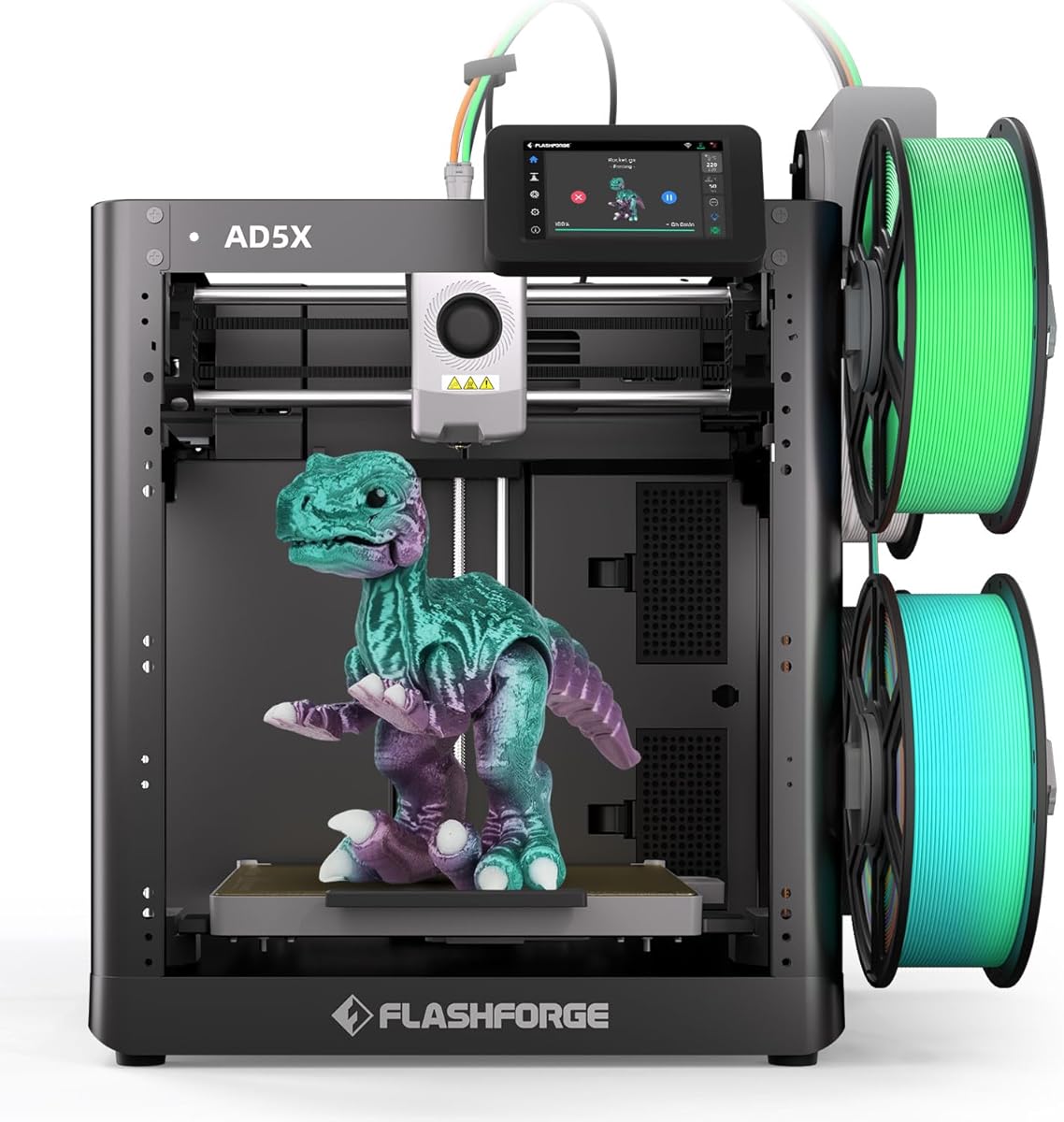
The FLASHFORGE AD5X supports four-color printing via its Intelligent Filament System. It reaches 600mm/s with 20000mm/s² acceleration and a 300°C nozzle for engineering filaments. The all-metal Core XY structure enhances stability during high-speed runs.
We may earn a commission when you buy through this link, at no additional cost to you.
Its filament management minimizes downtime by detecting and refilling spools automatically. TPU support adds versatility for flexible parts. The 220mm build volume accommodates medium-sized props alongside individual miniatures comfortably.
Some users report complexity in setup and calibration. However once configured it delivers vibrant detailed prints efficiently. The large temperature range supports advanced materials beyond basic PLA for durable gaming pieces.
Suitable for artists wanting color versatility without resin handling. It balances speed with material flexibility. Choose this if multi-color output and high nozzle temp are priorities for varied project types.
Simultaneous four-color capability allows intricate designs without manual swapping or purging.
Automatic detection and refill reduce interruptions keeping prints running smoothly for long durations.
We may earn a commission when you buy through this link, at no additional cost to you.
The phrozen Sonic Mini 8K S is a top pick for Dnd Miniatures due to its 22 micron resolution. It uses an 8K mono LCD for crisp details on faces and textures. Designed for beginners it offers value with precision out of the box.
We may earn a commission when you buy through this link, at no additional cost to you.
Open source software compatibility ensures freedom to use preferred slicers like Lychee or Chitubox. The Z-axis calibration ensures even layers for vertical accuracy on tall figures. Compact design fits easily on desks or small workspaces.
Resin printing requires safety gear and curing steps which adds workflow complexity. The build volume suits individual models rather than large groups. However the detail level justifies these steps for display-quality miniatures.
This printer is perfect for hobbyists prioritizing surface quality over speed. It balances entry-level usability with professional detail. Choose this for highly detailed character pieces where fine features matter most.
22 micron XY resolution brings every nuance of your miniatures to life with sharp detail.
Open software support lets you use favorite slicers without restrictions for creative freedom.
We may earn a commission when you buy through this link, at no additional cost to you.
The Bambu Lab P1S provides an enclosed FDM solution ideal for varied filament types. It prints up to 500mm/s and supports multi-color printing with an AMS attachment. Auto bed leveling simplifies first layers ensuring reliability for miniatures.
We may earn a commission when you buy through this link, at no additional cost to you.
Its enclosure maintains thermal stability for engineering materials like ABS or ASA. Setup takes about fifteen minutes allowing immediate printing. User-friendly design reduces learning curves for new users wanting professional results quickly.
While it lacks native multi-color, the AMS expands capabilities. Some may find the price higher than non-enclosed alternatives. Still the reliability and speed make it a strong contender for consistent output.
Great for users needing material flexibility and enclosed stability. It handles both standard and advanced filaments well. Choose this if enclosure benefits and fast reliable printing are key priorities.
Lightning-fast speeds reduce wait times so you can focus on creating more models.
Fully enclosed body improves performance for advanced filaments and temperature consistency.
We may earn a commission when you buy through this link, at no additional cost to you.
The FLASHFORGE Adventurer 5M Pro features a 3-second quick-swap nozzle system for easy tool changes. It prints at 600mm/s with a CoreXY structure reducing vibrations. Enclosed design operates quietly under 50dB for home offices.
We may earn a commission when you buy through this link, at no additional cost to you.
Auto leveling ensures precise calibration every time. A 280°C nozzle supports engineering materials reliably. Built-in camera enables real-time monitoring for remote oversight of long prints.
Some user feedback notes setup quirks but performance remains solid once configured. The quiet operation is a plus for shared spaces. Color printing is not native but speed and material support compensate.
Ideal for makers needing fast reliable prints with minimal noise. Easy maintenance and monitoring add value. Choose this for efficient daily use where speed and quiet matter most.
Effortless nozzle replacements across multiple sizes save time during maintenance and upgrades.
Built-in camera allows real-time monitoring and time-lapse creation for full control.
We may earn a commission when you buy through this link, at no additional cost to you.
The FLASHFORGE AD5X Multi supports four-color output via Intelligent Filament System. It reaches 600mm/s with vibration compensation for smooth surfaces. Full auto leveling sensors ensure consistent first layers for reliable prints.
We may earn a commission when you buy through this link, at no additional cost to you.
Its compact design saves space while supporting varied materials like TPU or PETG-CF. Side-by-side spools offer flexibility for custom color palettes. Calibration is automated reducing manual intervention.
Some users face initial learning curves with filament management. Once mastered productivity improves significantly. The multi-material capability expands creative options beyond single-color models.
Suitable for creators wanting color versatility in a small footprint. It balances speed and flexibility well. Choose this if multi-material support and space-saving design are important.
Print multiple colors and materials simultaneously using the Intelligent Filament System for varied projects.
All-metal motion reduces vibration ensuring precise layer alignment for better print quality.
We may earn a commission when you buy through this link, at no additional cost to you.
The Bambu Lab A1 Mini brings multi-color capabilities in a compact package. It offers 10000 mm/s² acceleration with automatic calibration. The AMS lite included enables vibrant prints without manual swaps.
We may earn a commission when you buy through this link, at no additional cost to you.
Setup takes roughly twenty minutes thanks to pre-assembled parts. Active motor noise cancellation keeps operations quiet at 48dB. The interface remains simple for quick navigation during printing.
Its small build size limits large projects but fits most miniatures well. Trade-offs include needing additional units for bigger needs. However for individual figures this is highly efficient.
Perfect for limited spaces needing quality multi-color prints. It balances size with performance. Choose this for small batch miniatures where quiet and speed matter.
AMS lite integration makes vibrant multi-color prints accessible for all users easily.
User-friendly interface and active noise canceling ensure a quiet focused printing environment.
We may earn a commission when you buy through this link, at no additional cost to you.
The Snapmaker U1 stands out with four independent toolheads enabling true multi-material prints. Tool changes occur in five seconds reducing waste and time. It prints up to 500 mm/s with CoreXY stability.
We may earn a commission when you buy through this link, at no additional cost to you.
Smart calibration handles offsets and vibration automatically. Compatibility includes PLA TPU and engineering materials without purging. The large build volume supports bigger props alongside detailed miniatures comfortably.
Premium pricing and system complexity may deter beginners. Yet productivity gains and print quality are unmatched for multi-material projects. Setup guides ease entry for new users.
Ideal for professionals needing maximum flexibility and efficiency. It excels in complex multi-material prototypes. Choose this if premium tooling and minimal waste are top priorities.
Four independent toolheads enable multi-color and multi-material prints without manual intervention.
Tool swapping reduces waste by five times increasing speed and lowering costs.
We may earn a commission when you buy through this link, at no additional cost to you.
The Anycubic Kobra X offers native four-color capability out of the box. It accelerates to 600mm/s with LeviQ 3.0 auto leveling ensuring flat first layers. Smart AI detects issues and manages models remotely via app.
We may earn a commission when you buy through this link, at no additional cost to you.
Dual-band Wi-Fi and LAN support flexible control. A hardened nozzle supports up to 300°C for tough materials. Large print size accommodates big projects with ease.
Filaments are not included so budget for supplies separately. Initial calibration may require patience but results stabilize quickly. The system reduces purging and travel distance saving time.
Great for users wanting plug-and-play multi-color simplicity. App control adds modern convenience. Choose this for ease of setup and reliable color output.
Four built-in colors with expandability offer vibrant output right from the start.
Remote control and detection features keep your prints safe and manageable from anywhere.
We may earn a commission when you buy through this link, at no additional cost to you.
Selecting the ideal printer depends on detail needs volume and technical comfort.
FDM printers use filament and are easier to maintain while resin printers deliver higher detail for miniatures. Consider your tolerance for post-processing and safety when choosing.
Resin is best for fine details while FDM suits larger props and faster production.
XY resolution defines the smallest visible feature size. For miniatures aim for 25 microns or lower to capture facial features and textures clearly.
Higher resolution ensures crisp details but may increase print times.
Measure your largest model height and width against the printer capacity. Larger volumes allow printing multiple figures at once reducing total time.
Ensure the build volume fits your workspace and project scale needs.
High-speed printers reduce waiting for multiple batches. Look for acceleration rates above 5000 mm/s² to maintain detail while printing quickly.
Faster speeds help but verify quality consistency at max settings.
Auto calibration systems save time and improve success rates for beginners. Manual leveling is possible but requires more patience and skill.
Prioritize models with auto leveling to ensure reliable first layers.
Check if the printer supports PLA PETG or TPU for flexible props. Higher nozzle temperatures allow engineering filaments for durable parts.
Versatile material support expands your project options significantly.
Open-source slicers give more control over settings. Proprietary software may simplify workflow but limit customization options.
Ensure the printer works with preferred slicing tools for ease.
Consider total costs including tools consumables and potential upgrades. Entry models save money but premium ones offer reliability and speed.
Set a realistic budget balancing cost and expected output quality.
Always start by leveling the bed and testing a small calibration cube. This ensures the first layer adheres properly to prevent warping or failed prints.
Clean the nozzle regularly and replace worn tips to maintain consistent extrusion. For resin printers wash models with alcohol and cure under UV light fully.
Store filament in dry containers to avoid moisture issues. Calibrate periodically to compensate for wear and ensure consistent quality over time.
Resin printers like the phrozen Sonic Mini 8K S excel for fine detail. Their XY resolution captures features that FDM may miss.
Yes especially with 0.2mm nozzles and optimized settings. Models like Bambu Lab A1 offer good detail for larger props and figures.
Resin prints take 1 to 3 hours per figure depending on size. FDM prints vary by detail but often range 2 to 6 hours per model.
For FDM printers yes unless native multi-color exists. Resin printers use paint or resin mix instead so AMS isn't needed.
Resin requires gloves and ventilation but is manageable. FDM is safer and easier if you prefer less exposure to chemicals.
Lychee and Chitubox suit resin users while Bambu Studio and PrusaSlicer work for FDM. Choose based on printer compatibility.
Clean the bed and nozzle after every few prints. Replace resin vat films every 10 prints to maintain clarity and performance.
Lubricate rails monthly and check belts for tension. Update firmware to ensure smooth operations and bug fixes.
Our top picks highlight options balancing cost speed and detail. The phrozen Sonic Mini 8K S leads for detail while Bambu Lab A1 offers FDM ease.
Prioritize resolution and ease of use to match your skill level. Beginners benefit from auto calibration while pros may prefer speed and versatility.
Always verify current availability and support before buying. With the right printer you can bring any character or prop to life for your Dnd campaigns.