
LAFVIN R3 Camera Smart Robot Car
4.5Editor score
Wi-Fi remote control
Five intelligent operation modes
Open-source learning platform
This guide compares ten top Arduino robot kits for kids and beginners, evaluating features like sensors, coding options, and build quality to help you choose
Arduino robot kits offer an engaging way to learn coding, electronics, and engineering through hands-on building. These kits combine mechanical assembly with programmable logic, making them perfect for students, hobbyists, and families exploring STEM fields together.
We evaluated ten leading kits based on build quality, sensor variety, coding flexibility, and educational value. Our comparison considers ease of assembly, availability of tutorials, and the ability to expand projects as skills grow over time.
Each pick highlights unique strengths like camera integration, tank tracks, or balancing mechanics. While specific costs vary by retailer, these selections represent the best options available today for different age groups and learning goals.
4.5Editor score

4.5Editor score

4.3Editor score
The following table provides a side-by-side overview of each kit’s core capabilities, including controller type, sensor suite, and primary learning focus to help you narrow down your choices quickly.


The ELEGOO UNO R3 Smart Robot Car Kit V4 stands out as the top choice for its combination of visual feedback and ease of use. With a 4.5 rating, it offers a complete package including an onboard camera for real-time video streaming.
We may earn a commission when you buy through this link, at no additional cost to you.
Its standout qualities include the ESP32-WROVER camera module which allows FPV control, plus keyed connectors that make wiring significantly easier for beginners. The included tutorial and example programs guide users from chassis assembly to programming.
While it requires adult guidance for initial setup and the remote needs a separate battery, these trade-offs are minor compared to the educational value. The rechargeable lithium-ion battery ensures extended play without constant replacements.
This kit is ideal for families, classrooms, or makers wanting a robust introduction to robotics. It balances complexity and accessibility perfectly, making it the best overall choice for most learners.
The onboard camera streams real-time video to a phone, helping users understand navigation and sensor data visually while controlling the robot remotely.
Keyed connectors and illustrated tutorials simplify the build process, allowing beginners to focus on coding and logic rather than struggling with complex wiring.
We may earn a commission when you buy through this link, at no additional cost to you.
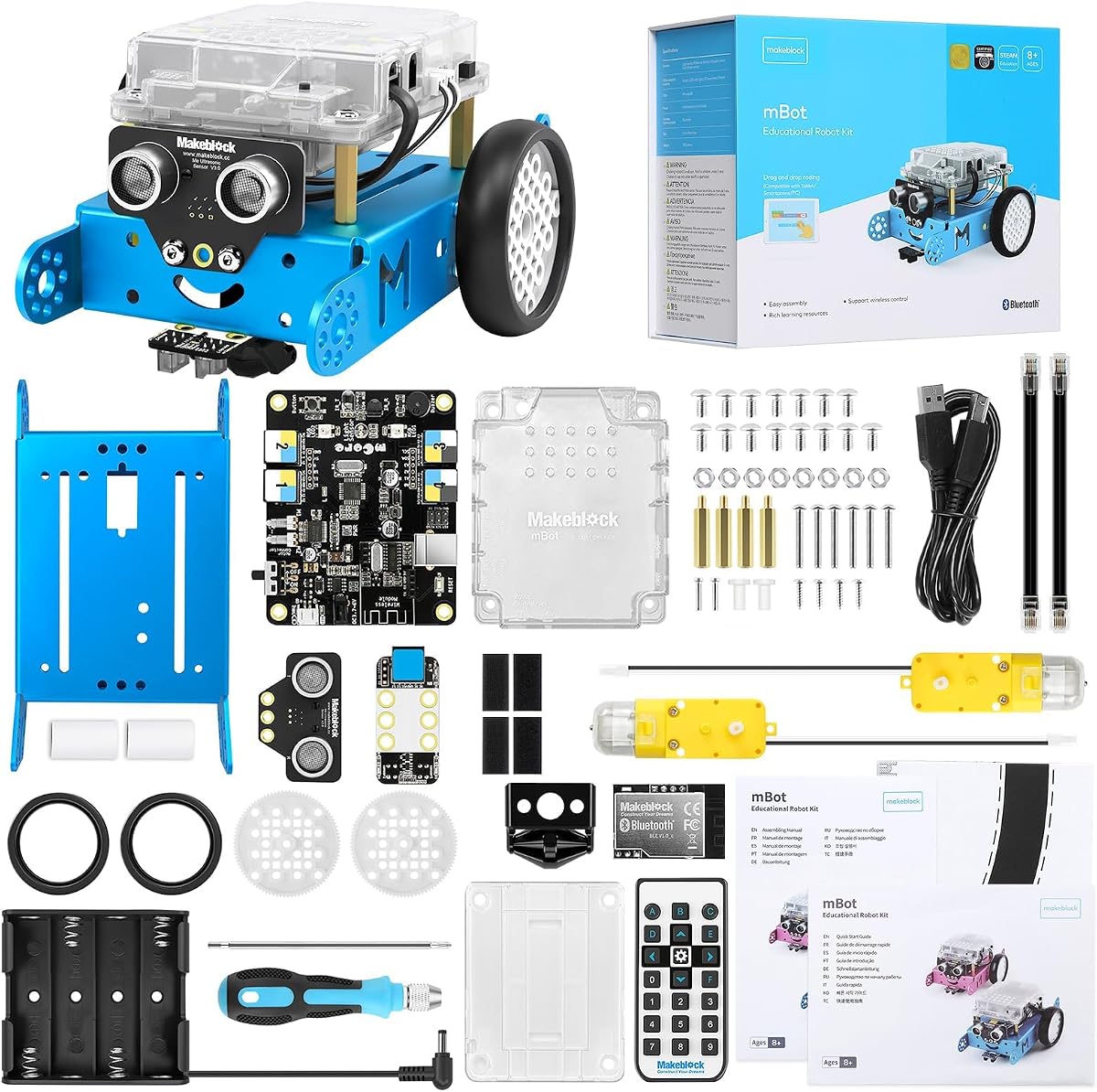
The Makeblock mBot is designed for children aged 8 to 12 and offers an entry-level experience that transitions smoothly from visual coding to text-based programming. Its 4.6 rating reflects high satisfaction among young users and educators.
We may earn a commission when you buy through this link, at no additional cost to you.
Key strengths include the ability to build the robot in about 15 minutes thanks to clear instructions. The rich tutorials and free Makeblock apps enable remote control and interactive gaming right out of the box.
The main drawback is that batteries for the remote and robot are not included, which can delay immediate play. However, the open-source system allows for expansion with over 100 electronic modules.
This kit is perfect for introducing robotics to elementary-aged kids who want a simple but rewarding project. It grows with the child as coding skills advance from Scratch to Arduino.
Children start with drag-and-drop blocks and naturally progress to Arduino C++, ensuring they build confidence before tackling text-based syntax.
Compatibility with Makeblock add-on packs and LEGO parts means the robot can evolve into more complex creations as interest deepens.
We may earn a commission when you buy through this link, at no additional cost to you.
The ELEGOO Conqueror Tank Kit brings a military-inspired aesthetic with a stainless-steel chassis and metal tracks. It supports five interactive modes including FPV driving and line tracking, making it versatile for different learning scenarios.
We may earn a commission when you buy through this link, at no additional cost to you.
Its standout features are the robust metal build and the servo-mounted camera that allows viewing angle changes during operation. The UNO R3 control system ensures compatibility with standard Arduino code.
While the heavier metal components make assembly slightly more involved, this adds to the realism and durability of the robot. It is best suited for older kids or adults looking for a tank-style project.
This kit is ideal for STEM classes focusing on mechanics and sensor integration. The combination of visual feedback and tactile build quality makes it a strong contender in the tank robot category.
Metal tracks and suspension simulate real tank movement, teaching users about traction and weight distribution in a fun way.
Users can switch between remote, auto, and FPV modes to experiment with different control strategies and navigation algorithms.
We may earn a commission when you buy through this link, at no additional cost to you.
The ELEGOO Tumbller introduces the concept of self-balancing robotics, which is both challenging and rewarding. It uses motion sensors and real-time motor control to stay upright, offering a hands-on physics experiment.
We may earn a commission when you buy through this link, at no additional cost to you.
Key strengths include six ways to play such as auto-follow and obstacle avoidance, plus LED effects that enhance visual feedback. The tutorial guides users through chassis assembly and balance tuning.
Balancing robots require careful calibration which can be tricky for absolute beginners. However, the ability to modify code for movement and logic makes it a valuable programming exercise.
This kit is recommended for users interested in control theory and feedback loops. It provides a unique challenge that distinguishes it from standard wheeled robot cars.
Building a self-balancing robot teaches inertia, center of mass, and PID control concepts in a tangible, interactive manner.
Beyond balancing, modes like bounce and obstacle avoidance add variety, keeping the robot engaging for multiple sessions.
We may earn a commission when you buy through this link, at no additional cost to you.
The ACEBOTT Smart Robot Car Kit stands out for its omnidirectional Mecanum wheels, allowing 360-degree movement in any direction. It is controlled by an advanced ESP32 board which simplifies wireless connectivity.
We may earn a commission when you buy through this link, at no additional cost to you.
Its standout features include 16 story-rich tutorials and a variety of expansion packs like cameras and robotic arms. This makes it highly adaptable for different learning paths and creative projects.
The kit does not include batteries and the overall rating is slightly lower than competitors, but the expandability compensates for this. It offers good value for those wanting customization options.
This kit is suitable for teens and adults interested in navigation and path planning. The Mecanum wheels provide unique capabilities not found in standard two-wheel robots.
Mecanum wheels allow sideways and diagonal movement, enabling complex navigation tasks like parking in tight spaces.
Optional packs for solar power, camera recognition, and robotic arms allow users to tailor the kit to specific interests.
We may earn a commission when you buy through this link, at no additional cost to you.
The LAFVIN R3 offers Wi-Fi video streaming and a pan-tilt camera at a very accessible price point. It supports five intelligent modes including obstacle avoidance and object following, making it versatile.
We may earn a commission when you buy through this link, at no additional cost to you.
Key strengths are its built-in ESP32-S3 module which enables remote control and video streaming via mobile devices. The open-source platform provides plenty of free tutorials and code.
Assembly requires self-assembly which builds logical thinking but might take longer than pre-assembled options. The plastic construction is lighter but may be less durable than metal kits.
This is an excellent choice for budget-conscious learners who want advanced features like FPV. It balances cost and functionality well, making it a great value option.
Real-time video streaming via Wi-Fi is rare at this price point, offering an immersive control experience.
The open-source ecosystem ensures users can find code examples and guides easily online.
We may earn a commission when you buy through this link, at no additional cost to you.
The ACEBOTT 4 in 1 kit offers versatility by including a base car, tank tracks, and a 5DOF robotic arm. It is compatible with Arduino and Scratch, allowing flexibility in coding approach.
We may earn a commission when you buy through this link, at no additional cost to you.
Its standout features are the ability to build multiple robot styles and the inclusion of an arm for grasping objects. The tank treads handle outdoor terrain effectively.
The lower rating indicates some users may find assembly or software tricky. However, the modular nature provides significant value for those wanting to build different types of robots.
This kit is ideal for teenagers looking to explore multiple aspects of robotics. It encourages creativity by allowing users to mix and match components.
Swapping wheels for tracks or adding an arm lets users learn about different mechanical systems and applications.
Building and coding a 5DOF arm introduces inverse kinematics and precision control concepts to learners.
We may earn a commission when you buy through this link, at no additional cost to you.
The SunFounder Ultimate Starter Kit is a broad educational package containing 192 items and 87 projects. It covers IoT, smart cars, and basic electronics with structured online tutorials.
We may earn a commission when you buy through this link, at no additional cost to you.
Its standout feature is the expert-designed courses that cater to beginners and advance to complex topics like IoT integration. It is perfect for someone wanting more than just a robot car.
While not a single robot, it includes components to build one and much more. The community forum and technical help support a seamless learning experience.
This kit is recommended for students committed to a long learning journey. It provides a complete resource to build a strong foundation in electronics and coding.
Projects range from blinking LEDs to complex IoT systems, providing a full curriculum in one box.
Step-by-step lessons ensure learners do not miss key concepts while building confidence over time.
We may earn a commission when you buy through this link, at no additional cost to you.
The Makeblock mBot Ultimate is a premium kit designed for teenagers and adults who want a robust and expandable platform. It allows building 10 unique models using industrial-grade aluminum alloy parts.
We may earn a commission when you buy through this link, at no additional cost to you.
Key strengths include the MegaPi control board that supports multiple motors and servos in sync. It can even integrate with a Raspberry Pi for advanced machine vision projects.
The higher price and complexity require a greater investment of time and money. However, the durability and professional-grade components make it worth it for serious projects.
This kit is ideal for makers aiming to build complex, long-lasting robots. It offers a level of sophistication that bridges the gap between hobby and professional prototyping.
Aluminum alloy parts provide durability and precision, mimicking real industrial robot construction.
Support for Raspberry Pi opens the door to AI and complex vision tasks beyond standard Arduino capabilities.
We may earn a commission when you buy through this link, at no additional cost to you.
The Freenove Hexapod Robot Kit offers a unique six-legged design that allows walking, crawling, and twisting movements. Each leg has three motors controlled independently for versatile motion.
We may earn a commission when you buy through this link, at no additional cost to you.
Its standout qualities are the ability to control via remote or phone app and the prewritten code library which simplifies programming. The detailed tutorial guides assembly step by step.
The main drawback is the lack of included batteries and the detailed assembly required. However, the unique walking gait and control make it a fascinating project.
This kit is perfect for those intrigued by biomimicry and walking robots. It challenges users to think beyond wheels and explore different forms of locomotion.
The six-legged structure mimics insects and spiders, offering a real-world engineering challenge.
Each motor is controllable separately, allowing for custom movements and gait patterns.
We may earn a commission when you buy through this link, at no additional cost to you.
Choosing the right kit depends on age, budget, and learning goals. Consider these factors to ensure the robot aligns with your technical skills and educational objectives.
Most kits specify age ranges such as 8+, 10+, or 12+. Younger kids benefit from simpler assembly and visual coding, while teens can handle more complex mechanics and text code.
Select a kit within the recommended age range to avoid frustration or boredom.
Some kits require full assembly from scratch which builds wiring skills. Others come partially assembled to save time. Consider how much hands-on mechanical work you want to do.
More complex builds teach engineering but take longer to complete.
Look for support for Scratch or Blockly for beginners and Arduino IDE for advanced users. A smooth transition path helps learners grow their skills over time.
Choose a kit that matches your current coding comfort level.
Sensors like ultrasonic, line tracking, and cameras enable interactive behaviors. More sensors allow for richer projects and complex navigation challenges.
Ensure the kit includes the sensors you need for your intended projects.
Some platforms offer add-on packs or modular designs that let you upgrade with arms or different wheels. This extends the learning value beyond the initial build.
Prioritize kits that grow with your interests and skills.
Tutorials, example code, and community forums are essential for troubleshooting. Kits with structured courses or video support reduce the learning curve significantly.
Check if the manufacturer provides clear documentation and active support.
Rechargeable batteries are convenient but add cost. Disposable battery kits are cheaper upfront but incur ongoing expenses. Check what is included in the box.
Consider the long-term power needs of your robot.
Metal components generally last longer than plastic parts. Industrial-grade aluminum offers robustness but adds weight. Choose based on how much rough use the robot will see.
Higher durability ensures longevity for classrooms or heavy play.
Always follow the manufacturer's assembly guide to ensure correct wiring. Double-check connections before powering on to prevent short circuits that could damage the controller.
Store the robot and components in a dry place to protect electronics from moisture. Keep small screws and parts organized in containers to avoid loss during future builds.
Update firmware and drivers regularly if your kit supports them. Proper maintenance of batteries and sensors ensures consistent performance over time.
No prior experience is required for most beginner kits. Many offer visual block coding to get started. However, some basic understanding helps with customization later.
Most kits use rechargeable lithium-ion batteries or standard AA batteries. Always check the box to see if batteries are included or need to be purchased separately.
Yes, most Arduino IDE tools and apps work on both Windows and Mac. Some kits also support tablets for control and coding via mobile applications.
Absolutely. Many educators use these kits in STEM programs. They support group learning and offer structured lessons for various grade levels.
Simple kits take around 15 to 30 minutes. More complex models with metal parts or many components can take a few hours over multiple sessions.
Contact the manufacturer for replacement parts if possible. Some brands sell replacement modules, or you can use a third-party electronics store to source equivalents.
The ELEGOO UNO R3 Smart Robot Car Kit V4 leads the list with its balance of FPV features and ease of use. For budget-conscious buyers, the LAFVIN R3 offers great value with wireless streaming.
When choosing, prioritize the features that matter most to your learning goals. Whether you want a walking hexapod or a tank, the right kit can inspire a lifetime of innovation.
Always verify current availability and shipping options on the product pages before purchasing. Conditions and stock can change rapidly, so checking directly ensures you get the best deal.