
FNIRSI DSO152 Handheld Oscilloscope
4.4Editor score
200kHz Bandwidth
2.5MS/s Sampling Rate
Portable Design
Finding the right tool for electronics work can be challenging when you are on a budget. A cheap oscilloscope offers a practical solution for hobbyists and professionals who need reliable waveform visualization without breaking the bank. These devices allow you to see electrical signals clearly, making troubleshooting and design work much more efficient than ever before.
We have carefully evaluated ten top-rated models based on their performance, features, and value for money. Our comparison looks at bandwidth, sampling rate, display quality, and additional tools like multimeters and signal generators. This list covers a wide range of options to ensure you find a device that matches your specific testing needs and preferences.
Each pick in this guide highlights key strengths and potential trade-offs to help you make an informed decision. We focus on real-world usability and build quality to ensure these models stand up to daily use in workshops or labs. Keep in mind that prices and availability can change over time, so always verify current details before purchasing your next tool.
4.4Editor score

4.3Editor score
4.3Editor score
As an Amazon Associate we earn from qualifying purchases.
This table provides a side-by-side look at the key specifications and features of all ten models discussed in this guide. Use it to quickly compare bandwidth, channels, and additional functions to narrow down your choices based on what matters most for your projects.


The FNIRSI DSO152 is an excellent entry-level option for anyone looking to get started with signal analysis without spending a fortune. It holds a strong rating from users who appreciate its simplicity and portability. This model is designed to be a pocket-friendly companion for quick checks and basic educational purposes.
We may earn a commission when you buy through this link, at no additional cost to you.
Its key strengths lie in its straightforward operation and reliable performance for low-frequency signals. The 2.5 MS/s sampling rate and 200 kHz bandwidth are sufficient for many hobbyist projects and automotive diagnostics. The one-key AUTO function makes it easy to set up measurements quickly, even for beginners who may not be familiar with oscilloscope settings.
Honest trade-offs include its limited bandwidth and smaller screen compared to more advanced models. While it handles periodic analog and aperiodic digital signals well, it may struggle with high-frequency applications. However, these limitations are acceptable given its price point and intended use case for casual users and students.
This device is ideal for hobbyists, students, and technicians who need a basic tool for fieldwork or classroom demonstrations. If you need a reliable and affordable oscilloscope for general testing, this model is a solid recommendation. It offers a great balance of functionality and cost for those just starting their electronics journey.
The lightweight and assembled design means you can take it anywhere without worrying about setup or carrying heavy gear.
With clear display and easy controls, this model reduces the learning curve for new users entering the field.
We may earn a commission when you buy through this link, at no additional cost to you.
The FNIRSI 2C53T stands out as a versatile tool that combines an oscilloscope, multimeter, and signal generator into a single device. It has earned a strong rating from users who value having multiple testing functions without needing separate instruments. This model is particularly appealing for those who want to consolidate their toolkit for efficiency.
We may earn a commission when you buy through this link, at no additional cost to you.
Its key strengths include the upgraded features like cursor measurement, persistence mode, and improved measuring range. The 50 MHz bandwidth and 250 MSa/s sampling rate provide decent performance for a wide array of electronic tasks. The inclusion of a 4.5-digit multimeter and signal generator adds significant value, making it a comprehensive solution for troubleshooting and testing.
Honest trade-offs involve some complexity in navigating the menus and average build quality compared to premium brands. While the hardware architecture is robust, the physical design may not feel as durable under heavy industrial use. However, these issues are acceptable for the price and functionality it delivers to most hobbyists and professionals.
This device is perfect for electronics enthusiasts, small workshop owners, and students who need a multi-functional tool. If you want a device that covers oscilloscope, multimeter, and signal generation needs, this is a great choice. It offers a high level of utility that justifies its position as an editorial pick for value.
Having three instruments in one reduces the need for multiple devices on your bench and saves valuable workspace.
Features like persistence mode and FFT analysis help you capture and visualize complex signals more effectively.
We may earn a commission when you buy through this link, at no additional cost to you.
The FNIRSI DSO-510 is a compact 2-in-1 device that pairs a handheld oscilloscope with a DDS signal generator. It has garnered positive ratings from users who appreciate its ability to generate signals directly from the unit. This model is well-suited for educational settings and simple circuit testing where portability is key.
We may earn a commission when you buy through this link, at no additional cost to you.
Its key strengths include the infinite afterglow feature that helps capture and view transient signal features clearly. The 10 MHz bandwidth and 48 MS/s sampling rate are adequate for low-frequency applications. The built-in signal generator can output up to 13 kinds of waveforms, which is useful for testing circuit responses without extra equipment.
Honest trade-offs include its low bandwidth and small screen which limit its use for advanced high-speed signal analysis. It may not be suitable for modern digital designs that require higher sampling rates or detailed waveform inspection. However, for its intended purpose of basic testing and learning, these limitations are reasonable.
This device is ideal for students, educators, and hobbyists who need a portable tool for signal injection and basic measurement. If you want a lightweight option that includes a signal generator, this is a strong candidate. It provides a convenient way to explore signal characteristics without investing in bulky lab equipment.
The infinite afterglow helps you see fleeting signals that might otherwise be missed on a standard display.
Generating waveforms directly on the device streamlines the testing process by eliminating the need for external sources.
We may earn a commission when you buy through this link, at no additional cost to you.
The FNIRSI DPOS350P is a powerful handheld oscilloscope designed for advanced signal analysis with a 350 MHz bandwidth. It has received a solid rating from users who need professional-grade features in a portable form factor. This model stands out for its ability to handle high-frequency signals and complex measurements effectively.
We may earn a commission when you buy through this link, at no additional cost to you.
Its key strengths include a 1 GSa/s sampling rate and advanced features like FFT-based spectrum analysis and frequency response analysis. The digital phosphor technology and large 7-inch touchscreen provide clear and detailed waveform visualization. With tools for harmonic markers and Bode plots, it is well-equipped for EMC checks and analog filter tuning.
Honest trade-offs include a more complex interface that requires time to master and higher power consumption. The touch interface and advanced features may be overkill for simple projects but are essential for serious engineers. However, these complexities are justified by the depth of analysis capabilities it provides for field and lab use.
This device is best suited for professional engineers, lab technicians, and advanced hobbyists working with RF or high-speed signals. If you need a portable scope that offers deep analytical tools, this is an excellent choice. It bridges the gap between benchtop performance and handheld convenience remarkably well.
The built-in spectrum analyzer allows you to detect EMI issues without needing a separate spectrum analyzer device.
This feature is invaluable for testing audio equipment and filters where phase and gain stability are critical.
We may earn a commission when you buy through this link, at no additional cost to you.
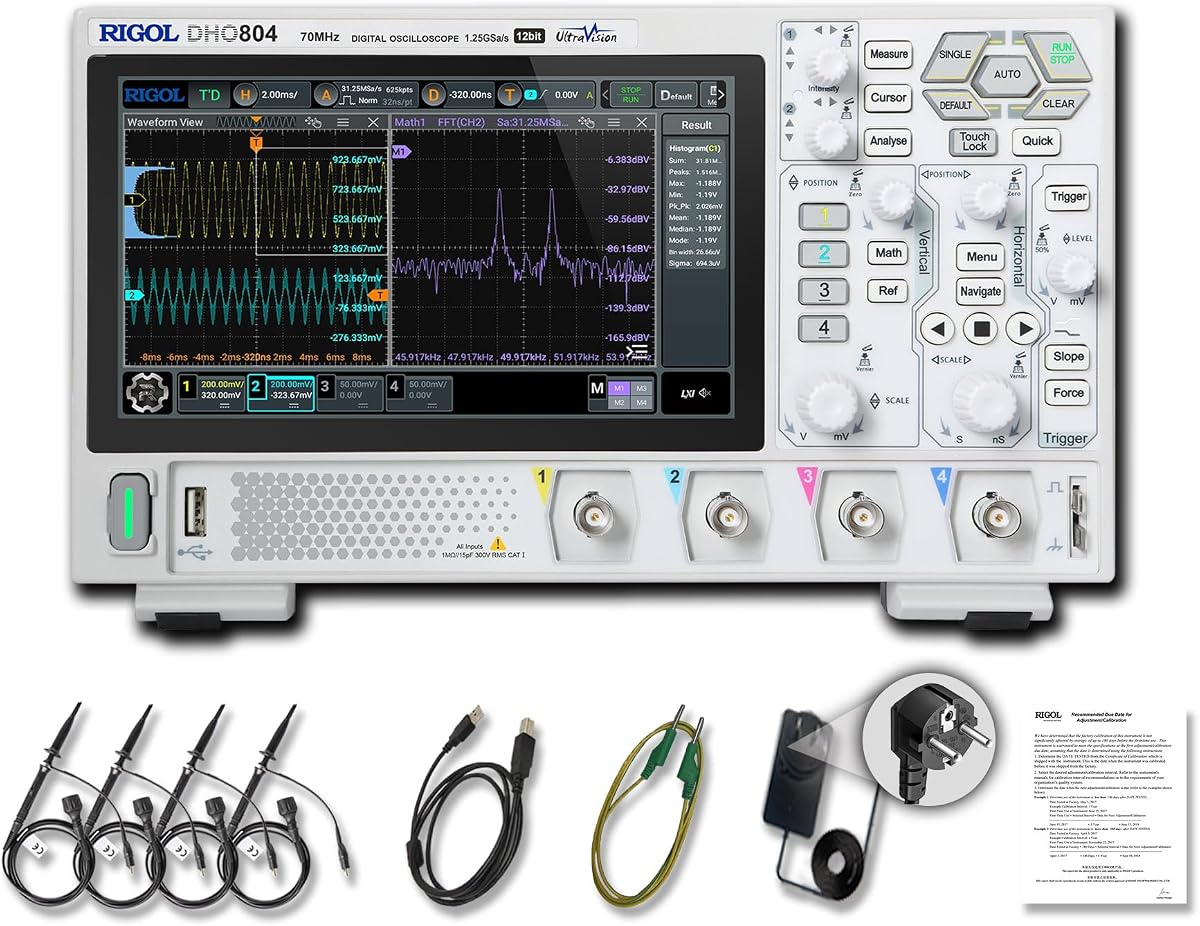
The RIGOL DHO804 is a premium portable oscilloscope known for its exceptional 12-bit vertical resolution and 4-channel capability. It holds a strong rating from professionals who demand high precision and reliable performance in their lab tools. This model is designed for users who need detailed signal insights and robust connectivity options.
We may earn a commission when you buy through this link, at no additional cost to you.
Its key strengths include the 1.25 GSa/s sampling rate and 25 Mpts memory depth which allow for extensive signal capture. The UltraAcquire mode helps find intermittent glitches quickly, and serial protocol decoding supports common interfaces like I2C and SPI. The 7-inch touchscreen and LAN support make it easy to integrate into modern test setups.
Honest trade-offs include its higher price point and weight compared to simpler handheld models. It may be less portable for field work but excels in a lab or teaching environment. However, the quality and feature set justify the investment for users who need professional-grade accuracy and durability.
This device is ideal for engineers, researchers, and educators who require high-resolution measurements and multi-channel analysis. If you prioritize performance and feature richness over portability, this is a top recommendation. It represents the gold standard for portable digital oscilloscopes in this price range.
Higher bit resolution captures subtle signal details that lower-resolution scopes might miss entirely.
Built-in decoding for CAN and SPI protocols simplifies troubleshooting embedded systems significantly.
We may earn a commission when you buy through this link, at no additional cost to you.
The FNIRSI 2C53P combines oscilloscope, multimeter, and signal generator functions with a 4.3-inch touchscreen interface. It offers a unique set of features for users who prefer touch controls for navigation and measurement. This model appeals to those looking for a versatile tool with a modern display and strong battery life.
We may earn a commission when you buy through this link, at no additional cost to you.
Its key strengths include the high-resolution IPS display and a large 4000 mAh battery that supports extended field work. The FFT spectrum analysis and X-Y mode allow for detailed signal comparison and harmonic estimation. The integrated multimeter provides accurate readings for voltage, current, resistance, and capacitance across a wide range.
Honest trade-offs involve some inconsistency in user experience and software stability as reported in reviews. While the hardware is capable, the interface may require patience to navigate smoothly. However, the feature set and display quality offer a compelling value proposition for many electronics enthusiasts.
This device is suitable for hobbyists and technicians who want a multifunctional tester with a touchscreen. If you need a 3-in-1 tool for a range of diagnostic tasks, this is a good fit. It balances functionality and cost effectively for general testing purposes.
Capacitive touch and gesture operations make waveform viewing and adjustment more intuitive for modern users.
A large capacity battery ensures you can work longer without needing frequent recharges during busy shifts.
We may earn a commission when you buy through this link, at no additional cost to you.
The FNIRSI 1013D Plus features a large 7-inch touchscreen and 100 MHz bandwidth for smooth and detailed waveform interaction. It is highly rated for its display quality and ease of use with gesture controls. This model is perfect for users who want a modern interface and advanced measurement tools in a portable unit.
We may earn a commission when you buy through this link, at no additional cost to you.
Its key strengths include the 1 GSa/s sampling rate and ample storage for screenshots and waveform data. The image manager allows for thumbnail browsing and zooming which speeds up analysis. The Lissajous and FFT viewing modes provide powerful ways to analyze signal relationships and harmonic content.
Honest trade-offs include the potential fragility of the glass screen and occasional software bugs that may require updates. The physical size also makes it less pocket-friendly compared to smaller handheld models. However, the visual experience and features it offers make it a strong contender in its class.
This device is great for users who prioritize screen real estate and intuitive touch controls for daily testing. If you want a clear and responsive interface for waveform analysis, this is a top choice. It delivers a premium feel at a reasonable price for most applications.
Gesture operations allow you to pan and zoom waveforms directly on the screen for quicker adjustments.
Storing screenshots and waveforms makes it easy to document results for reports or later review.
We may earn a commission when you buy through this link, at no additional cost to you.
The FNIRSI 2C23T is an entry-level 3-in-1 device that offers a mix of oscilloscope, multimeter, and signal generator functions. It has earned a high rating from users looking for a straightforward and budget-friendly testing tool. This model is ideal for beginners who need to perform basic electronic measurements without complexity.
We may earn a commission when you buy through this link, at no additional cost to you.
Its key strengths include the 10 MHz bandwidth and simple interface that reduces the learning curve. The multimeter mode supports a wide range of measurements including AC and DC voltage, current, and resistance. The FPGA and MCU hardware architecture ensure stable performance for everyday tasks.
Honest trade-offs include limited bandwidth and a basic set of features that may not suffice for complex projects. The 50 MSa/s sampling rate is low for digital signal analysis but acceptable for analog work. However, these limitations are well within expectations for an affordable entry-level unit.
This device is perfect for students and hobbyists starting their journey in electronics. If you need a basic tool to learn the fundamentals, this is a recommended choice. It provides essential functionality at a low cost to support education and simple repairs.
The simple layout and auto features make it easy to start taking measurements right out of the box.
Having a multimeter built-in saves you from carrying a separate tool for basic checks.
We may earn a commission when you buy through this link, at no additional cost to you.
The FNIRSI 2D15P is a 3-in-1 instrument that combines a 100 MHz oscilloscope with multimeter and signal generator functions. It holds a solid rating for its performance and practical design that supports extended field use. This model is well-suited for professionals who need higher bandwidth without a steep price increase.
We may earn a commission when you buy through this link, at no additional cost to you.
Its key strengths include the 500 MS/s sampling rate and flexible memory depth that capture detailed waveforms. The afterglow feature helps clear up cluttered traces, and the multimeter supports TRMS for accurate readings. The cooling fan ensures stable operation during long testing sessions without overheating.
Honest trade-offs include its weight and potential fan noise which may be distracting in quiet environments. While the hardware is robust, it is not as portable as smaller handheld models. However, the enhanced performance and reliability are worthwhile trade-offs for many technicians.
This device is ideal for technicians and engineers who need higher bandwidth and accurate measurements for daily tasks. If you want a balance between performance and cost, this is a strong option. It offers a lot of capability for a reasonable price.
This display mode helps visualize repetitive signals clearly by accumulating waveform data over time.
True RMS measurements ensure precise voltage and current readings even with non-sinusoidal signals.
We may earn a commission when you buy through this link, at no additional cost to you.
The 3 in 1 Handheld Oscilloscope is a compact tool that offers automotive and general electronics testing capabilities. It has received a strong rating for its ease of use and practical design for on-the-go work. This model is a great fit for technicians who need a reliable and portable device for diagnostics.
We may earn a commission when you buy through this link, at no additional cost to you.
Its key strengths include auto recognition of waveforms and a dual-channel setup for comparing signals effectively. The high-speed mode provides up to 50 MHz bandwidth for detailed signal analysis. The included multimeter and signal generator add further versatility without adding bulk to your kit.
Honest trade-offs include a lower memory depth and basic software that may limit advanced analysis. It is designed for quick troubleshooting rather than deep debugging sessions. However, for its intended use as a field tool, it performs reliably and efficiently.
This device is perfect for automotive technicians and general repair workers who need a portable multi-tool. If you want a compact scope that handles common tasks without fuss, this is a recommended choice. It offers a practical solution for field testing and quick checks.
Automatic waveform recognition speeds up the process of identifying unknown signals in complex circuits.
Comparing two channels side-by-side is essential for checking phase differences and signal alignment.
We may earn a commission when you buy through this link, at no additional cost to you.
Choosing the right cheap oscilloscope involves balancing technical specs with your specific needs and budget. Consider the following factors to ensure you pick a model that delivers the performance and features you require.
Bandwidth determines the highest frequency signal your oscilloscope can accurately display. For hobbyists and basic electronics, 50MHz to 100MHz is often sufficient. Professional or RF work might need 200MHz or higher to avoid distortion and loss of signal detail.
Look for a bandwidth that exceeds your highest expected signal frequency by at least four times for accurate results.
Sampling rate indicates how many data points the device captures per second. Higher rates allow for more detailed waveform reconstruction. A rate of at least five times the bandwidth is a good rule of thumb for capturing high-frequency components.
Choose a model with a sampling rate that supports your bandwidth needs to avoid missing glitches or noise.
Most affordable scopes come with two channels, which is enough for comparing signals. Four-channel options are available if you need to monitor multiple rails or signals simultaneously. Additional channels can add cost but provide valuable flexibility for complex circuit debugging.
Decide if two channels meet your current needs or if four are necessary for future projects.
The screen is your primary interface for viewing waveforms. A larger display helps you see details and navigate menus easily. Touchscreens offer intuitive control but may drain battery faster. Ensure the resolution is clear enough for your work environment.
Select a screen size that balances portability with readability for your typical usage scenarios.
Many cheap oscilloscopes now include multimeters and signal generators. These add significant value by consolidating multiple instruments into one device. If you frequently switch between tools, a 3-in-1 or 4-in-1 model can save time and cost.
Prioritize models with built-in tools that match your common tasks to improve efficiency.
For field use, battery life and weight are crucial. Larger batteries offer longer run times but increase the device size. Look for models with Type-C charging for convenient power management. Lightweight designs make transport easier and reduce fatigue.
Choose a battery capacity that supports your typical workday without needing frequent recharges.
Connectivity options like USB or Ethernet allow for data export and remote control. Good software support can enhance the device with updates and features. Consider if you need to save waveforms or share data with a computer regularly.
Ensure the oscilloscope supports data transfer methods that fit your workflow and reporting needs.
A high-voltage protection module is essential for safety when measuring mains or automotive signals. Rugged construction ensures the device survives bumps and drops in workshops. Check for certifications that indicate electrical safety standards.
Invest in a model with robust safety features to protect both yourself and your equipment.
Start by setting up the device on a stable surface and connecting the probes correctly to the ground and signal points. Calibrate the probe by adjusting the compensation screw until the square wave display is flat. This ensures your measurements are accurate before diving into complex diagnostics.
Use the auto-scale feature to quickly get a baseline waveform on screen. Then adjust the timebase and voltage scale manually to focus on the details you need. Save important waveforms to internal memory or export them to your computer for further analysis.
Keep the device clean and dry when not in use. Store it in a protective case to prevent damage to the screen and connectors. Regularly update the firmware to benefit from performance improvements and bug fixes provided by the manufacturer.
For most hobbyist and automotive work, 50MHz to 100MHz is sufficient. Higher frequencies require more bandwidth to capture fast edges accurately. Check your project's maximum signal frequency before selecting a model.
A 2-channel scope is usually enough for comparing two signals or ground references. A 4-channel model is better if you need to monitor multiple power rails simultaneously. Consider your complexity when choosing.
Only if the device and probes are rated for the voltage levels you are measuring. Look for high-voltage protection and appropriate safety certifications. Never connect a standard scope directly to mains without safety precautions.
Many modern affordable models combine an oscilloscope with a multimeter. This adds value by allowing you to check voltage, current, and resistance without another tool. Look for 3-in-1 options if this suits your workflow.
A higher sampling rate allows the scope to capture more details of the waveform. Aim for a rate that is at least five times your desired bandwidth. Insufficient sampling can cause aliasing and loss of data.
Most modern scopes include USB or Ethernet ports for data transfer. You can export waveforms and screenshots for analysis or documentation. Check the connectivity options before purchasing to ensure compatibility.
Choosing from the top picks in this guide offers a great starting point for finding a reliable and affordable oscilloscope. Each model brings unique strengths whether it is high bandwidth, touchscreen controls, or multi-tool versatility. Consider your specific needs to narrow down the best fit for your projects.
Prioritize features like bandwidth and sampling rate that align with the signals you intend to measure. Portability and battery life are also critical if you work outside a lab environment. Balancing performance with budget will lead to a smarter investment for your workshop.
Always check current prices and availability before purchasing as market conditions change regularly. Reviews and product updates may also affect the value proposition of each model. With the right choice, you will have a powerful tool for your electronics adventures.