
Siraya Tech Tenacious Flexible
4.7Editor score
Soft rubber-like flexibility
Enhanced rebound elasticity
Excellent resin additive
This expert guide compares the best flexible resin for 3D printing in October 2026. We review ten top products for durability, elasticity, and print quality to
Flexible resin for 3D printing allows creators to produce parts that bend, stretch, and absorb shock like rubber or TPU. Unlike standard rigid resins, these materials offer unique mechanical properties ideal for gaskets, grips, and wearable prototypes. Selecting the right formulation ensures your prints survive stress without cracking or losing shape.
We compared ten leading flexible resins based on shore hardness, elongation at break, print speed, and surface finish. Our analysis covers compatibility with common LCD and SLA printers, odor levels, and post-processing ease. Each product was evaluated for its balance between softness and structural integrity to find the most reliable options.
Each pick below highlights key strengths and ideal use cases for different project requirements. From budget-friendly options to premium elastomers, this list helps you match material properties to your design goals. Please note that availability and stock levels change frequently so verify details before purchasing.
4.7Editor score
4.7Editor score
4.2Editor score
The following table provides a side-by-side comparison of all ten flexible resin products evaluated in this guide. It highlights key specifications such as shore hardness, package weight, and primary use cases to help you quickly identify the best match for your specific printing needs and printer compatibility.



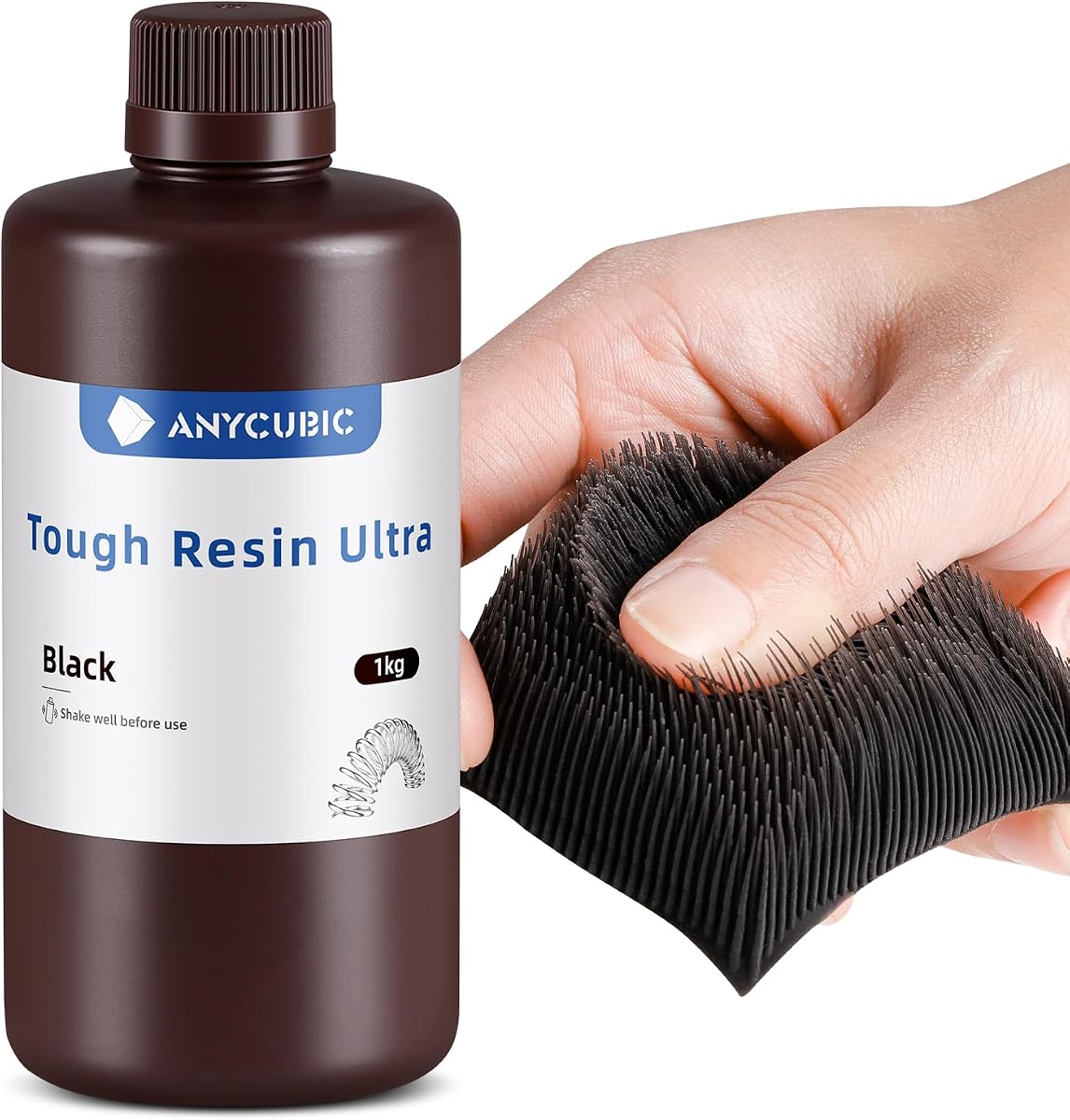
The ANYCUBIC Ultra Tough Resin stands out as the top choice for flexible 3D printing due to its exceptional impact resistance and remarkable resilience. With a 4.7 rating, it delivers superb flexibility that allows printed models to recover their original shape quickly after deformation from external forces.
We may earn a commission when you buy through this link, at no additional cost to you.
Its capacity to withstand damage makes it ideal for crafting articulated models and daily wearable items like earphone covers. The resin ensures a non-irritating experience on the skin, offering enhanced flexibility for a superior touch and feel that is gentle during extended wear.
While blending with other resins can affect final color outcomes, this material retains high elasticity and flexibility even in extreme temperature conditions. It exhibits remarkable resistance to brittleness and corrosion, ensuring outstanding performance in high humidity or damp environments where other resins might fail.
This product is highly recommended for makers seeking a versatile flexible resin that balances strength with elasticity. Whether used directly or as an additive to enhance other resins, it provides the durability needed for robust functional prototypes and durable end-use parts.
This material retains high elasticity and flexibility, ensuring outstanding performance in extreme temperature conditions without softening or deforming.
It proves effective for direct model making as well as serving as a valuable additive when blended with other resins for enhanced properties.
We may earn a commission when you buy through this link, at no additional cost to you.
Siraya Tech Tenacious Flex Black offers significantly softer and more rubber-like flexibility than the classic Tenacious resin. With a 4.7 rating, this new formulation provides faster rebound and incredible elasticity, making it perfect for flexible and resilient 3D prints that need to absorb shocks.
We may earn a commission when you buy through this link, at no additional cost to you.
It withstands extreme bending and compression, quickly returning to its original shape due to superior elasticity. The high impact resistance ensures that accidental drops or impacts do not cause deformations or cracks, making printed objects durable yet not brittle for practical applications.
Ideal for projects requiring high flexibility, this resin is suitable for soft grips, gaskets, and shock-absorbing components. It also serves as an excellent resin additive, allowing you to mix it with tough resins to boost their impact resistance and flexibility significantly.
This product is a top budget choice for creators needing reliable flexibility without compromising on durability. While it may not suit all applications where the original resin is used, its specialized formulation offers dynamic performance for resilient prototypes and functional parts.
Withstands extreme bending and compression, quickly returning to its original shape with superior elasticity compared to standard formulations.
Ideal for projects requiring high flexibility such as soft grips, gaskets, shock-absorbing components, and pliable prototypes.
We may earn a commission when you buy through this link, at no additional cost to you.
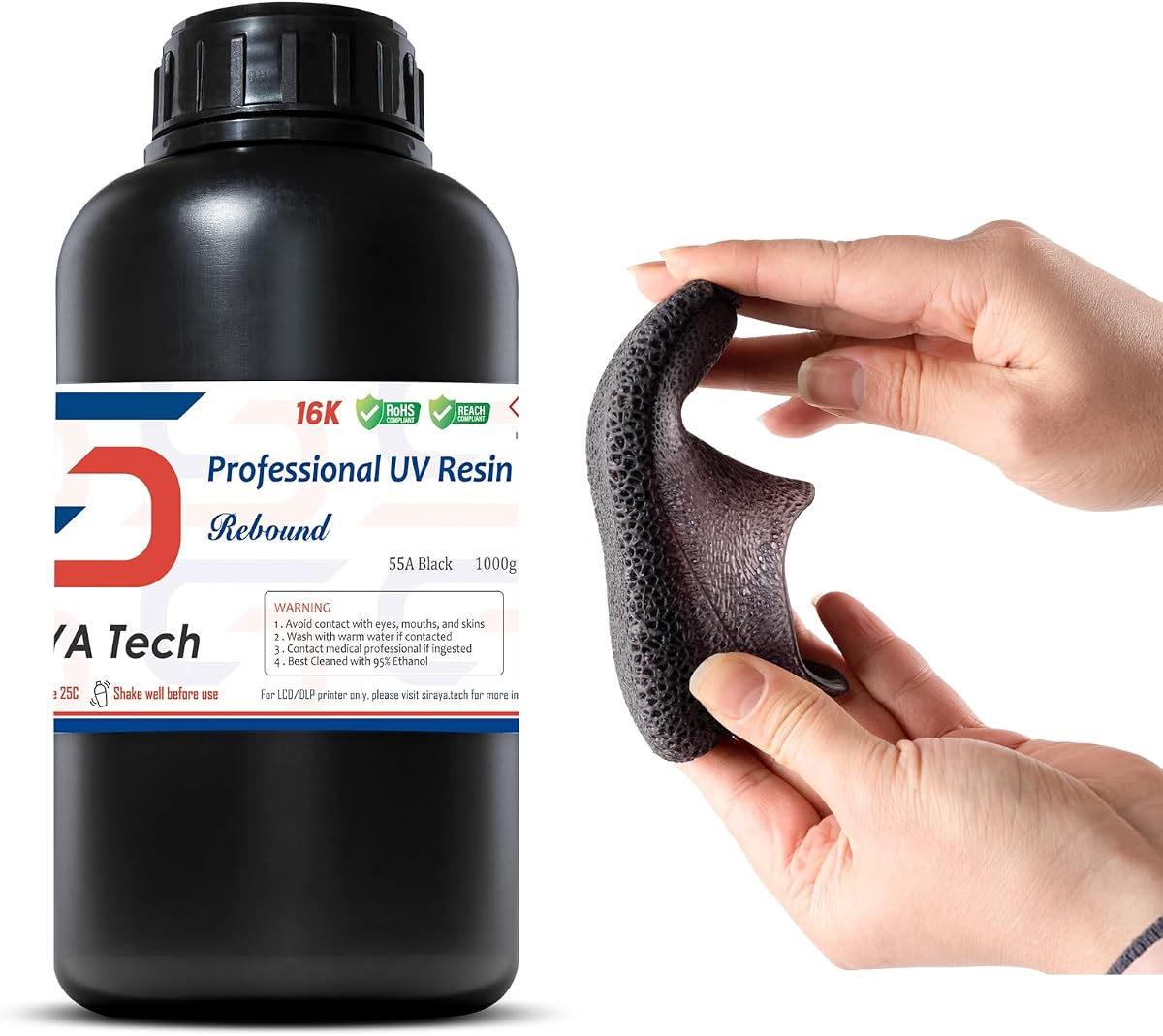
Siraya Tech Rebound 55A provides significantly faster rebound than standard elastic resins, making it an excellent choice for applications where quick shape recovery is critical. With a 4.2 rating, this high elasticity resin offers a balanced mix of flexibility and structural integrity for shock-absorbing components.
We may earn a commission when you buy through this link, at no additional cost to you.
Its promising durability shows good resilience during compression cycles, with potential for maintaining elasticity over repeated use. It prints on standard LCD and DLP 3D resin printers and cleans with standard isopropyl alcohol methods without requiring A/B mixing or complex processing steps.
While long-term performance testing is ongoing, this material is well-suited for personal protective equipment prototypes and industrial prototyping like gaskets and seals. The 55A shore hardness ensures it is softer than Tenacious Flex while maintaining excellent compression properties for demanding prototypes.
This premium option is recommended for projects where elasticity and rebound performance are important factors. Its versatile prototyping applications cover consumer products and industrial needs, offering a reliable solution for parts that must flex and recover repeatedly without degradation.
Provides significantly faster rebound than standard elastic resins, making it excellent for applications where quick shape recovery is needed.
Well-suited for personal protective equipment prototypes, shock-absorbing components, consumer products, and industrial prototyping.
We may earn a commission when you buy through this link, at no additional cost to you.
SUNLU Flexible 3D Printer Resin offers a perfect balance of softness and strength, simulating rubber or durable flexible prototypes. With a 3.5 rating, it features 70A Shore hardness and 135% elongation at break, exhibiting formidable strength and flexibility for various printing applications.
We may earn a commission when you buy through this link, at no additional cost to you.
It offers excellent impact resistance, making printed models durable and able to withstand drops without breaking. The smooth finish provides a high-resolution surface, and after cleaning, you get a dry, non-sticky surface with a pleasant touch suitable for many projects.
The material has a low shrinkage rate, providing accurate size and shape of printed parts. However, it has an aromatic odor that is not pungent and does not cause irritation. It includes a leak-proof bottle design to reduce damage during transportation, ensuring safe delivery to users.
This resin is suitable for most printing needs, showing good tolerance to weak acids and greases. Its compatibility with 99% of printers makes it a versatile option for LCD, DLP, and SLA users seeking affordable flexible materials with consistent quality for bendable items.
Offers excellent impact resistance and flexibility, making printed models durable and able to withstand drops without breaking.
Printing wavelength is 365-405nm, which is compatible with 99% of printers on the market, including LCD, DLP, and SLA.
We may earn a commission when you buy through this link, at no additional cost to you.
ANYCUBIC Tough Resin 2.0 has undergone a comprehensive upgrade with enhanced flexural strength, making it less prone to fracture. With a 4.6 rating, it exhibits formidable strength and flexibility, effectively resisting peeling and stress marks caused by cyclic vibrations.
We may earn a commission when you buy through this link, at no additional cost to you.
Its strong elongation ensures models are less prone to breakage even when dropped from a height. The formulation is low-odor and non-irritating, creating a calm and comfortable printing environment by significantly reducing volatile organic compounds for a greener choice.
High precision and minimal shrinkage allow for smooth surfaces and clear details in printed models. It is designed to be compatible with most LCD Resin 3D Printers and optimized for printing wavelengths between 365nm and 405nm for consistent performance.
Applicable for all kinds of models including industrial spare parts and building models, this resin suits rigid requirements. It is ideal for DIY, maker design, and daily design where high-strength model production is needed alongside functional flexibility.
Demonstrates enhanced toughness, making it less prone to fracture when printing miniature components and thin models effectively.
Applicable for all kinds of models, shells, and parts with rigid requirements, such as industrial spare parts and building models.
We may earn a commission when you buy through this link, at no additional cost to you.
SUNLU High Toughness 3D Resin offers long-lasting toughness with elongation 5 times higher than regular standard resin. With a 4.7 rating, it has excellent flexibility and bendability, making 3D printed models unbreakable and durable for structural parts and solid models.
We may earn a commission when you buy through this link, at no additional cost to you.
Its low viscosity and high flowability result in shorter curing time and easier model formation. With lower shrinkage, the potential for distortion is reduced, allowing you to achieve best-in-class accuracy and display crisp, vivid detail in your 3D resin prints.
It has a lower printing odor compared to other resins, providing a more comfortable printing environment. The printed model is not prone to cracking after wash and curing, greatly improving your 3D printing success rate and overall print quality results.
SUNLU has independent production lines for various resins, and this option is suitable for most LCD/DLP/SLA resin 3D printers. It is easy to use and can easily clean the print model with alcohol or ethanol, making maintenance simple for makers.
SUNLU toughness 3D resin's low viscosity and high flowability result in shorter curing time and easier model formation.
SUNLU high toughness 3d resin, the printed model will not prone to cracking after wash and curing, greatly improved your 3d printing success rate.
We may earn a commission when you buy through this link, at no additional cost to you.
ELEGOO Tough Resin has excellent flexibility and extraordinary resilience, making it easy to bend but not easy to break. With a 4.5 rating, it can withstand certain tension and stress, recovering quickly after deformation and showing strong damage resistance for functional parts.
We may earn a commission when you buy through this link, at no additional cost to you.
It has high-strength physical properties and can withstand certain impacts, suitable for printing structural parts and tools. The cured resin has a Shore hardness of 84.7D, exceeding that of others, and can be drilled without cracks during post-processing.
The material shows excellent resistance to brittleness, softening, and corrosion even in high humidity. It has high elasticity and flexibility, ensuring excellent performance under extreme temperature conditions while maintaining its structure over time.
This resin offers a low-odor, non-irritating formulation, providing a comfortable printing environment. It can be used for a wide application range including end-use products, functional prototypes, jigs and fixtures, and artistic projects with movable parts.
Has high-strength physical properties and can withstand certain impacts, suitable for printing structural parts, tools and other high-performance models.
Shows excellent resistance to brittleness, softening and corrosion even in high humidity or humid environments with high elasticity.
We may earn a commission when you buy through this link, at no additional cost to you.
Superflex 3D Printer Resin offers balanced softness and strength to simulate rubber or TPU for hard flexible prototypes. With a 4.4 rating, it prints 50um layers in 1.7 sec with monochrome LCD 3D printers, saving on time and electricity bill significantly.
We may earn a commission when you buy through this link, at no additional cost to you.
It has 80A Shore durometer and 100% elongation at break, well-suited for cushioning, damping, and shock absorption. Properly cleaned and fully post-cured prints pass ISO 10993-5 test, ensuring safety for specific medical or contact applications after preparation.
Super fast printing enhances the productivity of 3D printing farms by at least 40% and up. This makes it a strong choice for high-volume production environments where efficiency and cost management are critical for operational success.
The clear 500g package provides a transparent option for prototyping flexible parts. Its balanced properties make it ideal for applications needing a mix of softness and strength, delivering reliable performance for damping and shock absorption needs.
Printing 50um layer in 1.7 sec with monochrome LCD 3D printers, saving on time and electricity bill efficiently.
Super fast printing enhance the productivity of 3D printing farm by at least 40% and up for high efficiency.
We may earn a commission when you buy through this link, at no additional cost to you.
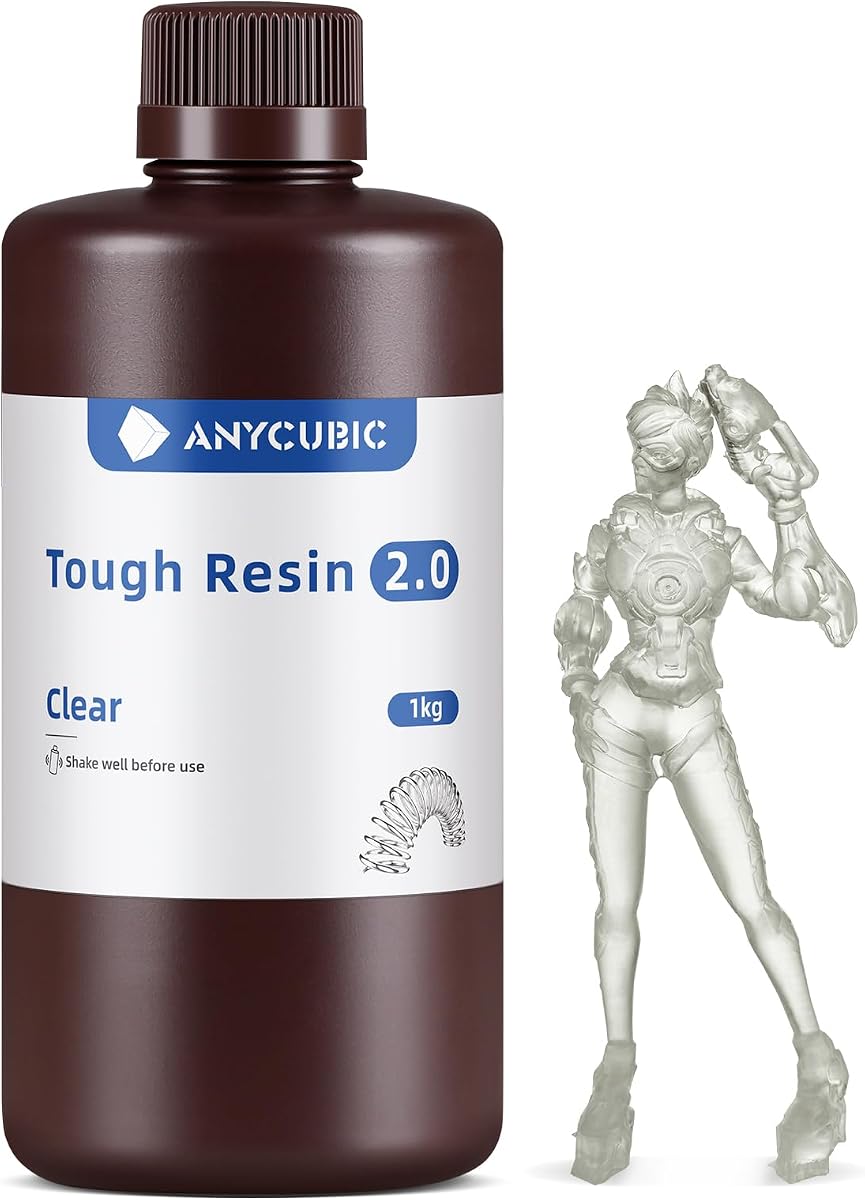
ANYCUBIC Tough Resin 2.0 offers superior toughness and significantly reduces the likelihood of breakage when printing delicate components. With a 4.6 rating, it provides exceptional strength and flexibility, resisting damage caused by cyclic vibrations and drops from a height.
We may earn a commission when you buy through this link, at no additional cost to you.
Its low-odor design cuts down volatile organic compounds, positioning itself as an environmentally friendly option for users. The resin ensures high-precision prints with minimal shrinkage, maintaining exceptional accuracy while remaining gentle on users during the printing process.
The clear 1kg package allows for visual inspection and specific aesthetic requirements. It offers versatile industrial applications and is highly compatible with different equipment and materials across various printer models and resin systems.
This product is designed for industry-wide compatibility, making it a reliable choice for diverse projects. It combines high hardness with precision, ensuring that prints remain durable and accurate even under stress and mechanical loads.
Achieved a significant enhancement in flexural strength, significantly reducing the likelihood of breakage when printing delicate components and thin models.
Offers versatile industrial applications and is highly compatible with different equipment and materials for broad support and use.
We may earn a commission when you buy through this link, at no additional cost to you.
This resin simulates rubber toughness with 90A Shore hardness, offering both softness and strength. With a 4.4 rating, the printed product can be folded and bent repeatedly without breaking, with strong tear resistance and good bending resistance for cushioning needs.
We may earn a commission when you buy through this link, at no additional cost to you.
It delivers high elongation and excellent tear resistance, making it the go-to choice for gaskets, protective cases, and ergonomic grips. This formula keeps its cool under stress, bending where ordinary resins snap for tough, reliable performance in various applications.
You do not have to sacrifice detail for flexibility as it delivers crisp, accurate prints with a low-odor formula. Perfect for technical applications and detailed models, it works great on most LCD and DLP printers in your workshop or garage.
Whether you are prototyping or producing end-use parts, it is ready to flex. From shock-absorbing components to cosplay props and flexible toys, this tough, flexible resin handles it all for makers, engineers, and designers seeking durability.
90A Shore hardness can simulate the toughness of rubber, with both softness and strength for folded and bent parts.
Works great on most LCD and DLP printers, handling shock-absorbing components, medical models, cosplay props, and flexible toys.
We may earn a commission when you buy through this link, at no additional cost to you.
Selecting the right flexible resin depends on your specific needs for hardness, elasticity, and print environment. Understanding these factors ensures your models perform as expected.
Shore hardness determines how soft or hard your printed object will be. Softer resins like 55A or 70A are better for rubber-like gaskets, while harder 80A or 90A options offer more structural support for functional parts that still need some flex.
Choose a hardness that matches your design requirements to balance flexibility with durability.
Elongation measures how much the material can stretch before breaking. Higher values mean greater stretchability and impact resistance. Look for resins with 100% or higher elongation if your parts will experience repeated bending or tension.
Prioritize high elongation ratings for applications needing dynamic movement or shock absorption.
Different resins cure at different rates under UV light. Fast-curing formulations save time and electricity, especially in large production runs. Check the recommended exposure times and ensure your printer is optimized for the resin wavelength.
Select a fast-curing resin if time and efficiency are key factors for your projects.
Most flexible resins are designed for 405nm LCD or DLP printers. Ensure your printer supports the specific wavelength requirements of the resin to achieve proper layer adhesion and avoid print failures due to under or over-curing.
Verify compatibility with your printer model before purchasing to ensure reliable results.
Some flexible resins have stronger odors due to their chemical formulation. Low-odor or non-irritating options are better for indoor printing spaces. Look for resins that pass safety tests like ISO 10993 if the part will have skin contact.
Choose low-odor resins for better comfort and safety in shared or home workspaces.
Flexible resins can be stickier or harder to clean than standard types. Look for materials that clean easily with alcohol or ethanol without degrading. Proper washing and curing are essential to avoid tacky surfaces or brittleness over time.
Consider the cleaning requirements when selecting a resin for ease of finishing.
High shrinkage during curing can distort printed dimensions. Low shrinkage resins provide more accurate parts. If dimensional accuracy is critical for fitting or assembly, check the shrinkage rates and choose a product with minimal distortion.
Select low shrinkage resins to ensure precise and reliable measurements in your prints.
Many flexible resins come in limited colors like black or gray. Some offer clear options for transparency. If you need specific aesthetics, check if the product offers the color you require or if you plan to paint prints after curing.
Check available colors to match your visual requirements or plan for post-painting.
Start by shaking the resin bottle well to ensure even distribution of additives. Pour the resin carefully into your printer tank to avoid spills. Use protective gloves and a mask when handling uncured liquid to minimize skin and respiratory exposure.
Print your model using the recommended exposure times for the specific resin. If you notice failures, adjust exposure slightly up or down. Flexible resins may require longer exposures than standard ones to ensure full curing and durability.
After printing, wash the model in isopropyl alcohol until all sticky residue is removed. Then cure the part under UV light according to the manufacturer guidelines. Proper curing maximizes the mechanical properties of the flexible material.
Flexible resin prioritizes elasticity and bending without breaking, often mimicking rubber. Tough resin focuses on impact resistance and preventing fractures, balancing some flexibility with stiffness for structural parts.
Yes, many flexible resins are skin-friendly and non-irritating after proper curing. Always ensure the product meets relevant safety standards and is fully washed before wearing for comfort and safety.
Use 90% or higher isopropyl alcohol to wash prints. Flexible resins can be sticky, so a longer wash time may be required. Change the alcohol once it becomes cloudy to ensure clean results.
Most are designed for 405nm LCD or DLP printers. Check the wavelength specifications on the product page to ensure compatibility with your specific printer model before purchase.
Yes, flexible resins often need more UV exposure to achieve full strength. Follow the manufacturer guidelines for curing to avoid tacky surfaces or weak mechanical properties over time.
Yes, mixing flexible resin with standard resin can add some flexibility. However, this may affect print settings and final color. Test small batches first to ensure consistent results and desired properties.
Store bottles in a cool, dry place away from direct sunlight to prevent premature curing. Seal the cap tightly after each use to avoid contamination and evaporation which can alter print quality.
Brittleness often results from under-curing or improper washing. Ensure adequate post-print UV exposure and clean residues thoroughly. Adjust exposure settings if the resin appears overly rigid after finishing.
We reviewed ten flexible resins ranging from ultra-soft to tough variants for various applications. Top picks like ANYCUBIC Ultra Tough and Siraya Tech Tenacious offer reliable performance for durable and flexible prototypes across different projects.
Prioritize factors like shore hardness, elongation, and compatibility with your printer. Consider odor levels and post-processing needs for your workspace. Choosing the right resin ensures your prints meet functional and aesthetic goals effectively.
Remember to check current stock levels and details before purchasing as availability changes frequently. With the right material, your 3D printed flexible parts can perform reliably in real-world applications and withstand daily use.